

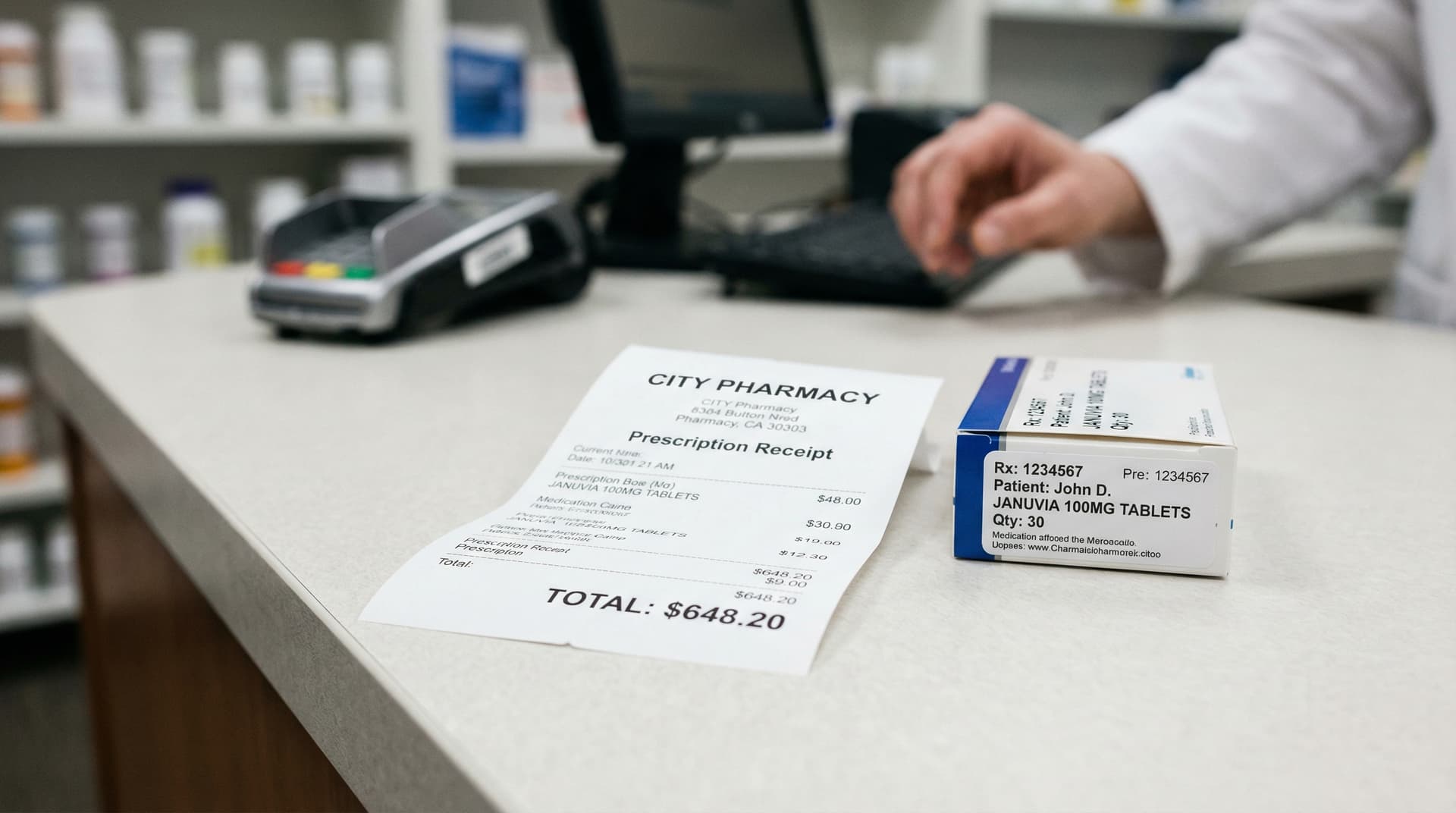
The Mounjaro Savings Card drops your monthly copay to as low as $25 — but only if you have commercial (employer or marketplace) insurance and a confirmed type 2 diabetes diagnosis. Patients without diabetes, on Medicare/Medicaid, or without commercial insurance are excluded by Eli Lilly's program terms.
Here's exactly how to qualify in 2026, the four things that disqualify you, the appeal path if your insurance denies prior authorization, and the legitimate alternatives if the $25 program isn't available to you.
Who actually qualifies for the $25 Mounjaro Savings Card?
Eli Lilly's official eligibility criteria, as of May 2026:
- You have commercial (private) insurance that covers Mounjaro for type 2 diabetes
- You have a confirmed type 2 diabetes diagnosis documented in your medical record (HbA1c ≥6.5%, fasting glucose ≥126 mg/dL, or random glucose ≥200 with symptoms)
- You are a US resident age 18+
- You are not enrolled in Medicare, Medicaid, TRICARE, VA, or any other federal/state program that pays for prescription drugs
If you meet all four: your copay is capped at $25/month for up to 13 fills per calendar year. Your insurance pays its share, the savings card covers the rest of your copay up to a maximum benefit (Lilly's program currently caps total Lilly contribution at $1,950/year, which is enough to cover the $25 copay for a full year on most commercial plans).
Who is excluded — the four disqualifiers
The four most common reasons patients don't qualify:
- No type 2 diabetes diagnosis. Mounjaro is FDA-approved only for type 2 diabetes. If your diagnosis is obesity, pre-diabetes, or metabolic syndrome (but not T2D), the Mounjaro card won't work. You'd need a Zepbound prescription instead — see our Zepbound = Mounjaro identity guide.
- Medicare or Medicaid coverage. Federal law prohibits manufacturer savings cards from being applied to drugs paid by Medicare Part D, Medicare Advantage, Medicaid, TRICARE, or VA. If you're on any of these, the $25 program is closed to you.
- No insurance. The savings card layers on top of commercial insurance — it doesn't work as a standalone discount. Without commercial coverage, the card does nothing.
- Insurance refuses to cover Mounjaro. Even with commercial insurance, your plan may exclude Mounjaro entirely or require a prior authorization you can't get approved. The savings card only kicks in after insurance pays its portion.
How to enroll in the Mounjaro Savings Card
Three steps. Total time: about 10 minutes.
- Visit lilly.com/mounjaro and click "Savings Card." Or go directly to mounjaro.lilly.com/save.
- Fill out the online form. You'll provide your name, date of birth, ZIP code, and confirm you have commercial insurance and a Mounjaro prescription.
- Save the card. You'll get a digital card with a Group, BIN, PCN, and Member ID. Show it to your pharmacy when filling your prescription. Most major pharmacy chains (CVS, Walgreens, Rite Aid, grocery store pharmacies) accept it automatically when you present the card.
The card is reusable across the calendar year, up to 13 fills. It auto-renews each January if you remain eligible.
What if my insurance refuses to cover Mounjaro?
Mounjaro coverage by commercial plans varies dramatically. Common scenarios and the fix for each:
- "Not on the formulary." Roughly 15% of commercial plans don't list Mounjaro at all. Your options: appeal (rarely successful for formulary exclusion), switch to a covered alternative (Ozempic or Trulicity are commonly covered for T2D), or pay cash.
- "Requires prior authorization." This is the most common gate. Your prescriber submits documentation: HbA1c results, prior treatments tried, BMI, blood sugar trends. Approval rates run 60–80% on first submission with complete documentation, 90%+ after appeal with metabolic data.
- "Requires step therapy." Your insurer wants you to try cheaper drugs first (typically metformin, then a sulfonylurea or DPP-4 inhibitor) before approving Mounjaro. If you've already tried these and they didn't work, your prescriber documents the failures in the appeal.
- "Denied as off-label." Your insurer is treating your prescription as weight-loss off-label and refusing. If your diagnosis is genuinely type 2 diabetes, your prescriber needs to submit the lab evidence. If it isn't, you need Zepbound instead.
For complex insurance navigation, providers our readers most often recommend:
- Eden Health — Board-certified physicians, in-house prior-auth submission, named-MD oversight. Strong track record on insurance appeals.
- TrimRx — Personalized doctor consultations include insurance navigation. Helpful for patients with PA complications.
- Ro — Only prescribes FDA-approved Mounjaro (and Zepbound), handles prior auths directly with insurer. Higher monthly cost than compounded options, but cleaner insurance path.
For the full ranking by which providers handle insurance complications, see our best GLP-1 telehealth programs list.
What if I can't get the $25 card? Legitimate alternatives in 2026
If the Mounjaro Savings Card is off the table for you, the cheapest legitimate paths to tirzepatide in 2026:
- Foundayo (oral tirzepatide, $149/month) — FDA-approved April 2026 via LillyDirect. Same molecule as Mounjaro and Zepbound, daily pill format. See our Foundayo how-to guide.
- Zepbound self-pay vials ($349–$549/month via LillyDirect) — Cheaper than Mounjaro pens at list price. Same molecule. Available without insurance.
- Compounded tirzepatide ($99–$299/month) — Available through telehealth providers. Legitimate when prescribed for medical necessity, but FDA enforcement against unsafe compounders has tightened. Use LegitScript-certified providers only — see our provider screening criteria.
- Medicare Bridge Program (~$50/month, launching July 1, 2026) — this CMS demonstration caps copays for Medicare Part D patients with qualifying diagnoses. See our Medicare GLP-1 Bridge Program guide.
What about the Zepbound Savings Card?
Eli Lilly also offers a Zepbound Savings Card with similar mechanics, but with a key difference: Zepbound's card caps at $650/month with commercial insurance, not $25. That's because Zepbound is for chronic weight management (often not covered) rather than type 2 diabetes (usually covered). When insurance does cover Zepbound, copays typically run $25–$200/month; the card brings down the patient cost but doesn't drop it to $25.
For weight-loss patients specifically, the LillyDirect Zepbound vial program at $349–$549/month is often cheaper than what the Zepbound Savings Card produces after a partial insurance payment.
Frequently asked questions
Is the Mounjaro Savings Card really $25 a month? Yes, for eligible patients. You may pay a small amount above $25 if your insurance has a higher copay design (some plans set Mounjaro at $200/month copay, in which case the card reduces it to $25 — you pay nothing more out of pocket up to the annual cap).
Does the Mounjaro card work without insurance? No. It only works as a layer on top of commercial insurance that covers Mounjaro. Without commercial coverage, the card does nothing.
Can I use the Mounjaro card with Medicare? No. Federal law prohibits manufacturer copay cards from being applied to drugs paid by Medicare Part D. This is firm — no workarounds.
What if I have type 2 diabetes but no insurance? Then the savings card doesn't apply. Cheapest path is GoodRx pricing on Mounjaro (typically $900–$1,000/month — still expensive), Foundayo at $149/month via LillyDirect (oral version), or a compounded tirzepatide program at $99–$299/month.
Can I get Mounjaro for weight loss with the $25 card? No. The card requires a type 2 diabetes diagnosis. If you have obesity but no diabetes, Mounjaro is off-label for you and won't qualify for the $25 card. Use Zepbound (the weight-management label of the same drug) instead — see our identity guide.
How long does the Mounjaro Savings Card last? Up to 13 fills per calendar year, auto-renews each January if you remain eligible. Annual maximum savings benefit is $1,950 in 2026.
What's the difference between the $25 card and the $25 coupon I see on GoodRx? GoodRx coupons are not Lilly's official Mounjaro Savings Card. GoodRx pricing on Mounjaro typically runs $900–$1,000/month with their coupon — not $25. The $25 figure refers only to Lilly's manufacturer savings card layered on top of commercial insurance.
Bottom line
The $25 Mounjaro Savings Card is real, easy to enroll in, and works seamlessly at the pharmacy — if you have commercial insurance and a confirmed type 2 diabetes diagnosis. For roughly half of patients seeking Mounjaro, those two conditions are met and the $25 path works immediately.
For the other half — patients with obesity (no diabetes), patients on Medicare/Medicaid, or patients without insurance — the realistic 2026 cheapest paths are Foundayo ($149/month oral pill) or compounded tirzepatide through a verified telehealth provider.
The single biggest factor between "this works" and "this is a nightmare" is whether your prescriber's office handles prior authorizations competently. Most large telehealth platforms now offer in-house PA submission. See our top-rated GLP-1 providers for the shortlist of programs with strong insurance navigation track records.